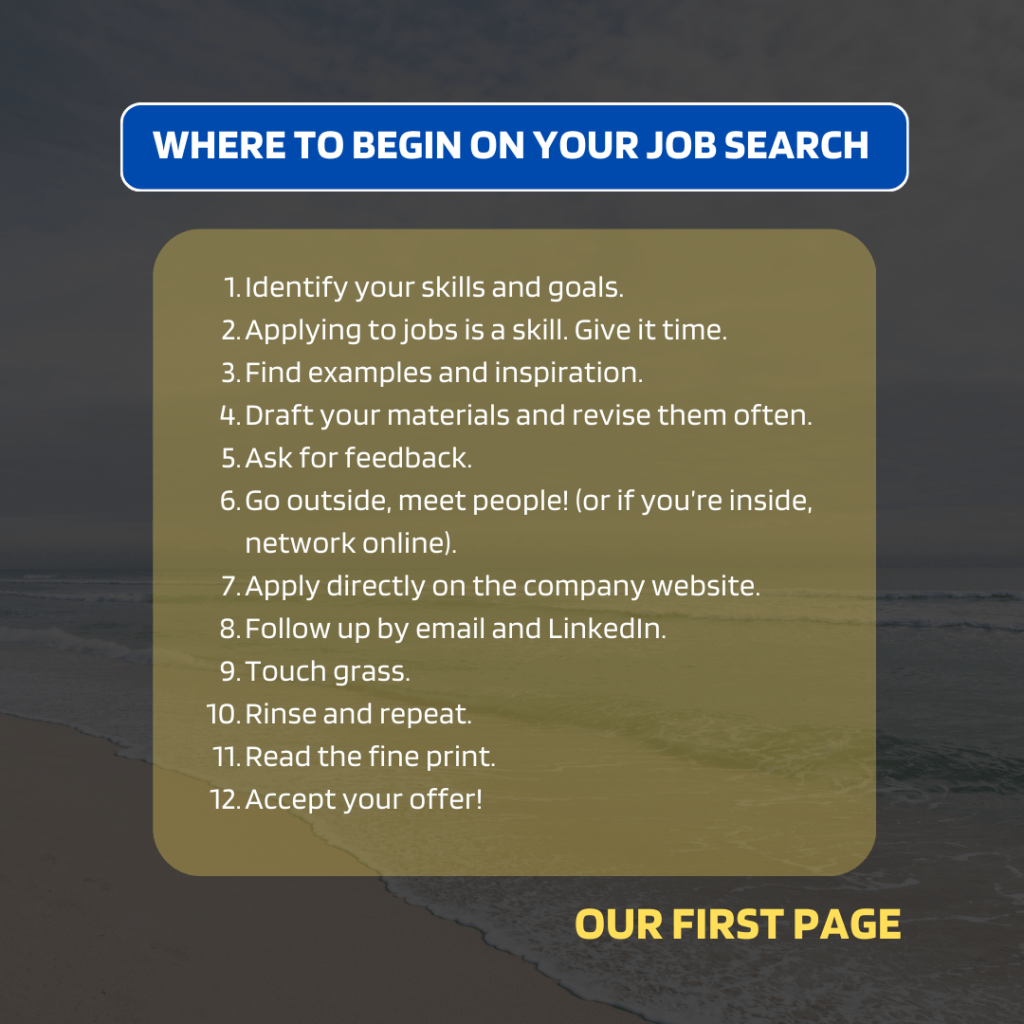
Where to begin on your job search.
To make our lives easier, I did some digging. I asked some experts, my professors, Google, LinkedIn, and my mentors, their advice on landing a new job. In this blog post, I’ll summarize some strategies and resources to keep in mind when it’s time to send in your applications.
- Identify your skills and goals
In our last blog post, How to make creative SMART goals smarter, we first looked at our own skills and interests to help us define our goals. If identifying your skills and goals are something you’re still unsure about, it might be worth starting there.
It’s important to have a sense of direction in your job search so you can better tailor your approach and your job application materials accordingly.
2. Give it time. Applying to jobs is a skill.
Like learning to read, write, or make the perfect poached egg takes time and practice. Learning to apply to jobs is a skill that also takes time. If you are a beginner and this is your first time applying for jobs I recommend reading some advice from Kelsey Alpaio from Harvard Business Review, who notes that when it comes to develop the skill of applying to jobs, “you need feedback to get better.”
Much like your best friends who help you make the right choices on what to wear and who not to text back, you need to have someone you can turn to for feedback on your job application materials. Just know that your first resume draft might be good, but an excellent resume might take some time.
3. Find examples and inspiration
There are many places to see past examples of resumes, portfolios, and professional branding. For an easy starting place, I suggest finding professionals you look up to on LinkedIn and taking some notes on how they have set up their career profiles. Hubspot has some great resume website examples with pointers on how to make your own.
4. Draft your materials and revise them often
Here are the types of job application materials you should always have prepared while you’re on a job search (some jobs ask for fewer or more things, but this is a general starting point).
- Curriculum Vitae: this document is a summary of your entire career background including education, experiences, publications, awards, or any other notable achievements. Academic institutions will often ask for this.
- Resume: this document summarizes your most relevant experiences in relation to the specific job and company you are applying for. Typically this is two pages in length.
- Have a basic resume with no special formatting so that it is easy for applicant tracking systems to read your information. Jobscan is a great tool to ensure that online job portals can read your file.
- Have a designed resume for when you send your resume directly to hiring managers or jobs that require an emailed resume.
- Cover Letter: this document is a short summary addressed to the hiring manager of the company you are applying to and gives a brief explanation on why your experiences and/or education are the best fit for the job you’re applying to.
- Online Portfolio: this is a digital collection of your relevant work. Common formats include websites, digital folders, or a digital document sent via a link. Personal portfolios are common and can be created on free website builders like Wix, Framer, or Canva.
- LinkedIn Profile: LinkedIn is a professional networking platform. A LinkedIn profile includes a summary of your updated, relevant professional experiences, projects, and skills. Hiring managers often look up a candidate’s LinkedIn profile to view their experiences, education, affiliations, skills, and online engagement. Think of this like Instagram but for your work life.
- A PDF or slide show of your portfolio: unlike your online portfolio, a PDF or slide show of your work experiences can be an additional, private, job application resource that you submit alongside your resume and cover letter. Some companies may ask for specific samples of your work when you apply to their company. Having a collection of your work in a packaged format can speed up the process of applying to a job.
- References: this is a list of people whom you trust to speak well about your skills and abilities. This can include your colleagues, managers, teachers, or volunteer supervisors. You will need to ask their permission to list them as a reference and you will need their basic information including their job title, company they work at (or where you worked together), their email, and a phone number. It’s best to have these details sorted early on, so that during reference checks there is no delay in responding to the hiring manager.
I know, it takes time to perfect the layout of your resume. And cover letter. And website. And portfolio. Give yourself some credit for getting those materials sorted. Keep in mind that all of these materials will need updating periodically.
5. Ask for feedback
During the job search there are a few times when it helps to ask for feedback.
Those include:
- While you draft your materials: you can always show your drafts to someone you trust to gain their feedback of what works and what needs improvement.
- After your materials are drafted: after things are adjusted, have another pair of eyes look at it to make sure that spelling and grammar are squeaky clean.
- Before an interview: connect with a mentor, people in your network, a career counsellor, a teacher, a friend, a colleague, or someone who understands the line of work you hope to get into. Ask them to look at your materials and ask if there are any areas that are confusing.
- Have a mock-interview: ask someone you trust to go over example interview questions. You can often find past interview questions online on Glassdoor.
- If you don’t have someone to ask who is knowledgeable on your career focus, you can also find one online through services like ADPList.com or fiverr.com.
6. Go outside, meet people! (or if you’re inside, network online).
One of the key pieces of advice that I’ve received throughout my career is to always seek out networking opportunities. Attending events, visiting social spaces, taking courses, joining activities, taking part in community activities, are all ways to meet people. It’s important to create meaningful connections with people you meet because you never know what opportunities may come from those connections. Be mindful of approaching new people with the wrong attitude.
Job related events also take place throughout the year. Pages like Eventbrite often post job fair events. You can search for job fairs in your neighbourhood. There are also job fairs
A primary space to network online is again through LinkedIn. There are many communities, groups, and events held online to help you connect with people in the same job market as you. You can also politely reach out to professionals on the platforms and ask to have a coffee chat. Not everyone will respond, but with time you will hear back.
People appreciate when their time and their experiences are valued. Avoid approaching people for the sole purpose of landing a job. Create connections, ask questions, and follow up. Once connections are made, it is easier to share that you are seeking out work opportunities. You’ll be surprised at how often people are willing to help.
7. Apply directly on the company website
If possible, leverage your network to gain referrals into job applications.
When applying to bigger companies, it is advisable to create an account on their job applications sites so you can better track your applications. While LinkedIn has an Easy Apply option, the success rate tends to be much lower compared to people who applied to a company’s website through a referral.
8. Follow up by email and LinkedIn
After sending in your application materials, do your research so you can stand out by sending the hiring manager a confirmation email. You can often find them through company pages on LinkedIn. This can help you to find the name and title of the person you are sending materials to. Try to use titles and names to show that you’ve done your research. You can also keep up to date with the companies you apply to by following their pages and checking their websites.
9. Touch grass.
Okay, maybe not literally (unless that’s something you enjoy). Take some time away from the job application process. Unplug from screens, connect with nature, friends, your hobbies, or things that energize you.
10. Rinse and repeat.
You’ll start to notice improvements in your job applications as you go through the process of creating your materials, getting feedback, networking, applying changes, and taking some time for rest and recovery.
11. Read the fine print.
Be cautious of fake job posters, scammers, and people posing as companies. Fake job offers can come via email, phone call, or even by text and Whatsapp message. Look up phone numbers and email addresses before responding to anything you don’t recognize. Any job offer from a company you haven’t heard of, didn’t apply to, yet is proposing a tremendous salary is something to question. With real job offers, make sure to take some time to read the conditions of the written agreement so that you can ask any clarifying questions before adding a signature. And generally speaking, any entry level job that is offering 100% commission without any base salary… is something to be skeptical towards.
12. Accept your offer!
Pretty self-explanatory. This is where you celebrate the new job! Eat some cake, call your loved ones, and enjoy the benefit of your hard work. Soon enough, it’s time to clock in.
 Our First Page
Leave a comment