Questions to answer before defining your SMART Goals
In this blog, we’ll go over
- What is a SMART Goal?
- How to prep for SMART goals.
It seems like every project or team I’ve worked on wants to work SMART. By SMART (all caps intended), I’m referring to the goal defining acronym that defines goals that are:
S – Specific
M – Measurable
A – Attainable
R – Realistic
T – Time-bound
For creative people, creating SMART goals are great to get a sense of structure towards the overall outcome of a goal. SMART goals help us take our ideas and refine them down into something tangible. For students and creatives like me, filling out SMART goals isn’t necessarily the issue. The issue is usually indecisiveness on what we want to focus our attention on.
Later in this blog, we’ll get deeper into how to make our SMART goals more personal (and easier to begin).
First let’s break down SMART goals:
To make the process even simpler I’ve broken it into steps:
- Pick one. Just pick one main goal and build from there.
- For now, pick one goal off your list and focus.
- It is completely okay to not have a super specific goal in mind yet.An example of a goal is: I want to start a YouTube Channel.
- Be Specific. (This is the S. in SMART Goals)
- Here is where you start to fill in your details.
- Ask what exactly does this goal involve?
- An example of a Specific goal is: I want to start a YouTube Channel where I review girly, fruity-floral perfumes (that’s just me, but you pick whatever you vibe with).
- Make it Measurable. (This is the M. in SMART Goals)
- Ask yourself how you will know if this goal is completed?
- An example of attaining this goal: I will achieve this goal by creating weekly videos, featuring trending perfumes, sharing my content on my website and social media, and including a call to action (such as subscribe to my channel) on my content.
- Ensure it is Attainable. (This is the A. in SMART Goals)
- Given the resources, knowledge, and timeframe you have, can it be done?
- An example of attaining this goal: I will achieve this goal by creating weekly videos, featuring trending perfumes, sharing my content on my website and social media, and including a call to action (such as subscribe to my channel) on my content.
- Ask is it Realistic? (This is the R. in SMART Goals)
- If you use your resources, stick to your timeline, and work consistently, is the goal realistic?
- An example of ensuring this goal is realistic: Once my content is shared, I will check regularly during the week to make sure my posted content has no disruptions and to engage with interactions.
- Make it Time-bound. (This is the T. In SMART Goals)
- How long will it take to achieve this goal?
- An example of setting time parameters: I will have one day per week dedicated to scheduling, editing, and producing my content.
- An example of a measurement is: I want to have 50 subscribers by the end of my first month.
So, the process seems straightforward (and it is). The struggle with setting up SMART goals at the beginning of your creative journey
Now that we have the basics of SMART goals templated, I want to introduce you to my prep work for SMART goals. My approach usually applies to personal goals and creative projects. It asks some introspective questions while identifying how that goal relates to you.
It’s one thing to say that we want to start a project, but it’s another thing to say that we want to start a specific project like starting a business writing a book or picking up on a past hobby that we really enjoyed. Starting with a general goal like picking up a project that we used to enjoy and adding in fine tune my new details can kind of weigh some of the clutter in our minds as to what we’re doing how we’re doing it and why we should do it in the first place. So, my approach to using smart goals, takes a few steps back to collect some inner work and inner data before we can even fill out that template.
Getting Introspective: Prep work for creative project SMART Goals
Pull out the pretty notebook you’ve been saving, a white board, a big napkin, or even the notes app on your phone. Press play on some brown noise or some lo-fi music, whatever suits your vibe today. Forget the SMART goals template for a minute (please).
First, I need you to answer these questions for me:
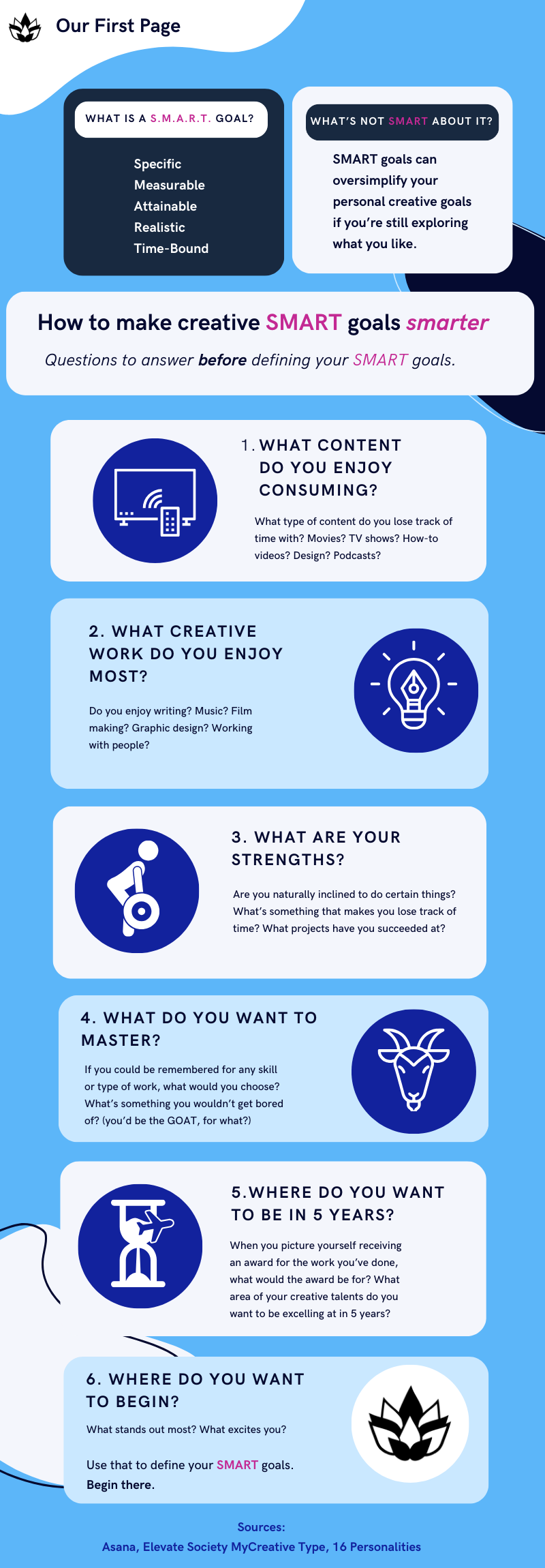
- What content do you enjoy consuming the most? (You might turn to this after a long day)
- What content do you enjoy creating the most? (You lose track of the hours when you start working on this)
- What projects were your strongest? (can be personal, schoolwork, or a closely kept secret project you’re proud of)
- What’s one skill you’re hoping to master? (There might be lots but pick the one you’d like people to remember you for)
- How does this project align with where you see yourself in 5 years? (I know, this might spark some existential crises but trust the process)
Now that you have some notes on where you gravitate towards most, you can start back at the top to define your SMART goals. It’s much easier to define smart goals when you’re excited about the topic you’re spending so much time on.
When it comes to making your creative SMART goals smarter, start with what you know and enjoy. In my experiences, the further I ventured away from the things that interested in me, the harder it was to define and work on my goals. When in doubt, turn back to our infographic cheat sheet on How to make creative SMART goals smarter. It’s s summary of this blog post that’s easy to turn back to.
Author’s Note:
If you’re still unsure about what you like, just know that not all creative people are the same. Find out your Creative Type here: https://mycreativetype.com/
If you want to dive deeper into introspection and get a holistic idea of your personality, strengths, weaknesses, communications styles, potential career paths, and more, start by finding out your personality type https://www.16personalities.com/

 Our First Page
Leave a comment